

Updated Educational Principles for North Rhine-Westphalia
Shaping Education Together from the Very Beginning.
They provide a shared pedagogical framework for specialists and teachers in child day care and daycare centers, as well as in all-day schools with a primary level, for the education, upbringing, and care of all children during their first ten years of life. The focus is on the child and his or her individual strengths, interests, and needs. Furthermore, these principles serve to develop a shared understanding of education—one that connects the various educational settings without compromising their respective roles and pedagogical characteristics.
Children actively shape their own educational and developmental processes. Good educational practice takes their interests into account, opens up new experiences, and supports them in exploring their environment with increasing independence and in collaboration with others.
The updated educational principles reinforce this holistic and resource-oriented view of the child. At the same time, they emphasize the special importance of relationships and interactions for educational processes. Recognizing these diverse educational opportunities in everyday life and shaping them pedagogically is a challenging and highly professional task.
The educational principles are intended to help accompany children consistently on their educational journey and to ensure successful transitions.
To bring this vision to life and make it tangible in everyday educational practice, the educational principles are organized into ten interlinked educational areas. They demonstrate how holistic support and relationship-based learning can go hand in hand in practice.
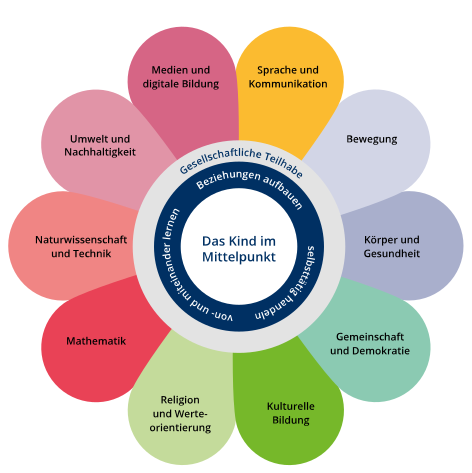
1. Language and Communication
Language development begins even before birth. A newborn’s very first sounds, movements, and reactions are part of a process that continues throughout life. Language serves a purpose far beyond simply communicating needs. Children use it to process experiences, reflect on what they’ve learned, and express and understand their feelings.
2. Exercise
Physical activity is a basic need. It strengthens motor skills, health, and well-being; a lack of physical activity, on the other hand, can hinder development. From early play through school and into leisure time, physical activity remains a central component of education.
3. Body and Health
Children’s learning processes are built on physical well-being, emotional security, and a fundamental sense of safety. Children develop a positive body image, become aware of their bodies and their capabilities, and view diversity as a matter of course. At the same time, they learn to recognize and respect the boundaries of others.
4. Community and Democracy
Democracy cannot be taken for granted; rather, it thrives when people understand it, value it, and actively help shape it. The foundations of democratic societies must be continually re-taught and brought to life. Democracy begins in our daily interactions. Children experience community, friendship, and solidarity; they practice consideration, learn to take on responsibility, and build trust.
5. Cultural Education
Children first explore their world through their senses. They hear, touch, see, smell, and taste, and process these impressions into inner images and ideas. Cultural education means perceiving the world with all the senses and expressing oneself creatively. Cultural education opens doors for all children. It also offers opportunities for self-expression to those who have limited verbal abilities, whether due to their age, a different native language, or a disability.
6. Religion and Values
Children approach the world with openness and wonder, developing their own ideas about what makes life valuable and meaningful. They experience fear and security, failure and success, hope and trust. Children contribute their questions and perspectives, make sense of their experiences, and search for answers together with others. Specialists and teachers encourage them to grasp connections, ask questions about where things come from, where they are going, and why, and to develop their own answers.
7. Mathematics
Mathematics is part of children’s lives from the very beginning. It is not just a school subject, but a natural part of their world: they encounter patterns, shapes, numbers, and comparisons everywhere. Mathematics opens up ways to create order, discover structures, and develop solutions to challenges.
8. Science and Technology
Children encounter science and technology everywhere in their daily lives: while cooking and baking, playing with water and sand, building things, observing animals and plants, or taking walks in nature. They learn that technical devices can be made, repaired, or modified.
9. Environment and Sustainability
When it comes to the environment and sustainability, children’s everyday experiences serve as the starting point. When they play outside, observe animals, plant seeds in the garden, or explore puddles when it rains, they experience nature with all their senses. Joy, wonder, a sense of security, and sometimes even fear or sadness—all of these are fundamental experiences that connect children to their environment.
10. Media and Digital Education
Digital media shape every aspect of life today. They are omnipresent and often barely noticeable because they are invisibly embedded in everyday devices and processes. For children and adults alike, it is simply a given that digital technology plays a role in nearly every area of life.